
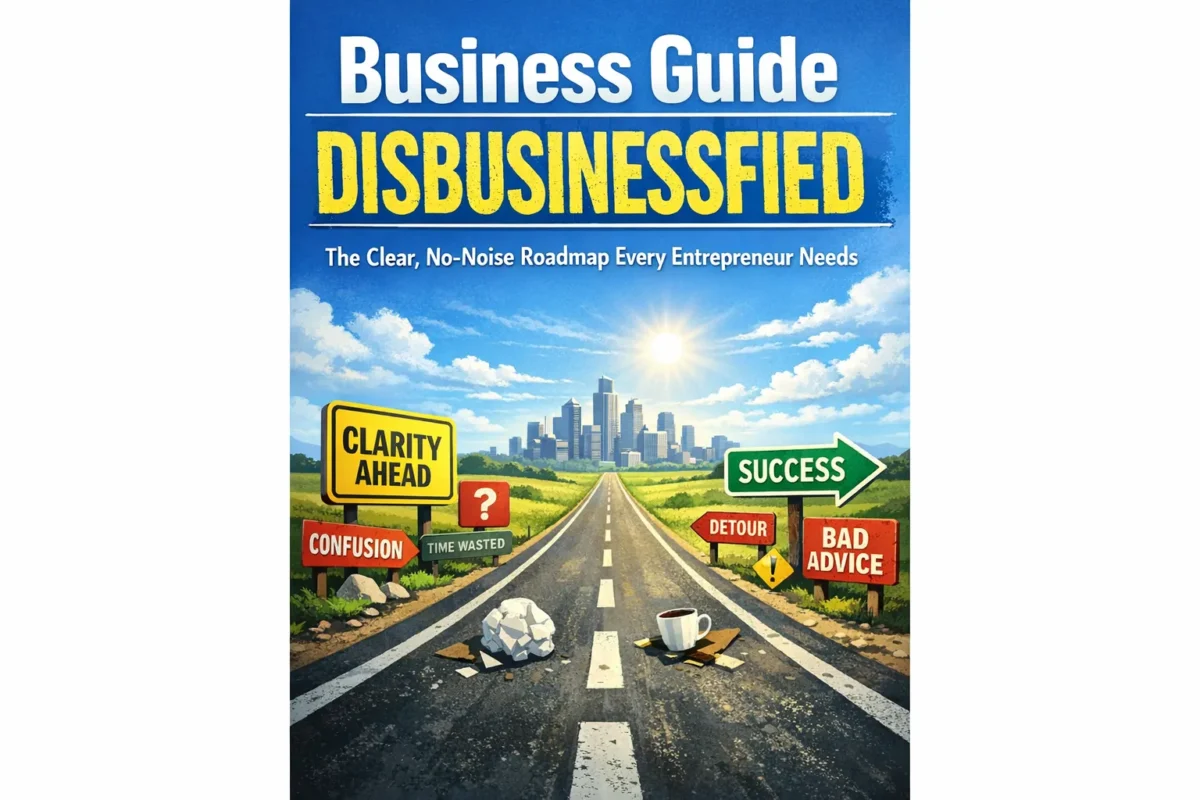
Business Guide Disbusinessfied: The Clear, No-Noise Roadmap Every Entrepreneur Need
Most business advice today feels like a maze. You search for clarity and come out more confused than when you started. Strategies pile up. Frameworks multiply. And somewhere in all that noise, the actual path forward disappears. That is exactly the problem the business guide disbusinessfied approach sets out to fix.
This guide is for entrepreneurs who want real answers, not recycled theory. You will learn how to identify a resilient business idea, build multiple revenue streams, make smart financial decisions, and scale without losing control of what you built. No fluff. No jargon storms. Just a grounded, practical roadmap that treats you like a thinking adult.
What Does “Disbusinessfied” Actually Mean?
Before anything else, let us define the term.
Disbusinessfied means stripping business down to its working parts. It removes the unnecessary complexity, the intimidating vocabulary, and the pressure to do everything at once. What remains is clarity, purpose, and action.
Think of it this way. A clock works because each gear does exactly one job. When you add unnecessary parts, the whole thing breaks. Business works the same way. The disbusinessfied approach keeps only what moves the clock forward.
This is not about dumbing things down. It is about cutting waste. Complexity is often a disguise for confusion, and confusion kills momentum.
Why Most Business Advice Fails Entrepreneurs
Here is the hard truth most business content will not tell you.
Generic advice is designed to sound smart, not to help you act. It tells you to “build a brand” without showing you how. It talks about “disrupting markets” without giving you a framework. It glorifies hustle without addressing risk.
The result? Entrepreneurs burn through savings chasing strategies that were never built for their stage of growth.
A disbusinessfied business guide focuses on three things instead:
1. Where you actually are right now 2. The next concrete step forward 3. What to measure so you know it is working
That is the whole system. Everything else is noise.
The Real Foundation — Solving a Problem Worth Solving
Every business starts with a problem. Not a product. Not a brand. A problem someone has and cannot solve on their own.
H3: Start With What You Know
The most resilient ideas come from personal experience. You understand the frustration. You know what a real solution would feel like. That head start matters more than most entrepreneurs realize.
According to research over 70% of businesses that scaled past seven figures began by solving a problem the founder had personally experienced. Familiarity reduces guesswork. And less guesswork means fewer expensive mistakes.
Validate Before You Build
Too many entrepreneurs build first and ask questions later. That approach wastes months and money.
Instead, talk to 20 real people in your target market within two weeks. Not surveys. Actual conversations. Ask them to walk you through the last time they faced the problem you want to solve. Listen for patterns. Those patterns are your product brief.
Then build the smallest possible test: a landing page, a one-paragraph offer, a simple mockup. Put a small budget behind it and see if anyone responds. Seventy-two hours of testing tells you more than six months of building.
The Four Revenue Stream Strategies You Need to Know
Single-income businesses are fragile. One market shift, one competitor launch, one platform change, and the whole thing wobbles.
The disbusinessfied approach to revenue diversification uses four strategies, ordered from lowest to highest risk.
Market Penetration
Sell more of what you already offer to your current customers. Zero learning curve. You know the product. You know the buyers. This is the safest starting point.
Market Development
Take your existing product to a new audience. Different city. Different demographic. Different use case. The risk steps up slightly because buyer expectations shift, but the product itself stays proven.
Product Development
Build something new for your existing customers. They already trust you, so the barrier to adoption is lower. The challenge here is execution, not relationship-building.
Full Diversification
New products for entirely new markets. Highest risk by a wide margin. But when the timing and research are right, the payoff can redefine a business entirely.
As noted in the Financial Age analysis of business guide disbusinessfied, companies that diversified strategically and aligned their revenue strategy to their risk tolerance outperformed single-channel competitors consistently over time.
Most strong businesses use more than one of these strategies at the same time. The key is knowing which one fits your current resources and risk appetite, then moving deliberately.
Building a Business Model That Actually Works
A business model answers one question: how does your business create and capture value?
That sounds simple because it is. Do not overcomplicate it.
Map it out on a single page. Who do you serve? What do you offer them? How do you deliver it? What does it cost you? What do they pay?
If you cannot explain it clearly in one minute, the model needs more work.
Keep Costs Intentional
Every expense should connect directly to value creation. Subscriptions, tools, and overhead grow fast when nobody is watching. Disbusinessfied businesses grow into expenses deliberately, never drown in them.
The rule: if a cost does not serve a customer or enable a sale, cut it before it becomes a habit.
Track the Right Numbers
Choose three metrics and own them completely. Customer acquisition cost tells you how expensive growth is. Time to breakeven tells you how long a new initiative needs to prove itself. Return on investment tells you whether the effort matches the reward.
If a new revenue stream cannot beat your existing ROI within 18 months, cut it and redirect the energy. That is not failure. That is smart capital allocation.
Branding Without the Buzzwords
Branding is not about logos or color palettes. It is about how people feel when they interact with your business.
Authentic branding comes from consistency between what you say and what you do. It is built on trust, and trust compounds. One broken promise can undo months of goodwill. So the simplest branding strategy is this: do what you say, every time, without exception.
Your story matters too. Why you started. What you believe. How you treat customers when things go wrong. These details shape perception more than any campaign ever will.
When branding is clear, marketing gets easier. People recognize you, remember you, and refer you, not because you were the loudest, but because you felt real.
Smart Financial Planning for Growth
Financial discipline separates businesses that survive from businesses that scale.
The biggest mistake entrepreneurs make when expanding? Funding new ventures from operating capital without a clear budget wall between old and new.
Follow the 10-15 rule: never allocate more than 10 to 15 percent of retained earnings to a new initiative in year one. Create a separate financial tracker for every new stream from day one. If you cannot see where every dollar goes, you cannot fix what breaks.
Self-funding works when your margins support the drain. External investment works when speed matters and you are willing to share control. Neither is wrong, but neither works without discipline.
Know your numbers before you spend. Review them weekly. Cut what does not work and double down on what does. That rhythm, maintained consistently, is what builds financially resilient businesses.
As Audit Futures points out, neglecting financial management is one of the most common and costly mistakes entrepreneurs make, especially in the early stages when every decision shapes the trajectory of the business.
Scaling Without Losing Control
Growth should feel intentional, not chaotic.
Scale when your systems are ready, not when ambition demands it. Strengthen the foundation before you expand the roof. Train your people. Refine your processes. Protect your culture.
Disbusinessfied scaling is steady and sustainable. Bigger is not always better. Better is always better.
Before adding a new market or product line, ask one question: can our current team and systems handle 50% more volume without breaking? If the answer is no, fix that first.
When you scale on a shaky foundation, you do not just risk the new venture. You risk everything you built.
Avoiding the Mistakes That Kill Good Businesses
A few patterns repeat themselves across failed businesses. Recognizing them early saves enormous amounts of time and capital.
Overcomplicating the product. Customers do not reward complexity. They reward clarity. Build the simplest version that solves the problem, then refine from feedback.
Ignoring cash flow. Profitable on paper does not mean safe in practice. A business can run out of cash while posting strong revenue if receivables lag behind payables. Watch cash flow weekly, not monthly.
Refusing to adapt. Markets shift. Platforms change rules. Consumer expectations evolve. The businesses that survive are not the strongest or the most funded. They are the most flexible.
Staying consistent, honest, and adaptable is not glamorous advice. But it is the actual formula.
Conclusion: Business Gets Simpler When You Build It Right
The business guide disbusinessfied philosophy is not about shortcuts. It is about focus.
Focus on a real problem. Validate before you build. Diversify deliberately. Track what matters. Spend with intention. Scale with discipline.
None of this requires a business degree or a large budget. It requires clarity, consistency, and the willingness to cut what does not serve your customers or your growth.
Your next step is simple. Pick one thing in your business right now that feels unnecessarily complex. Strip it down to its purpose. Ask whether it creates value or just creates noise. Then act on what you find.
The future of your business starts with that one honest decision.
FAQ: Business Guide Disbusinessfied
Q1: What is a business guide disbusinessfied and why do entrepreneurs need it?
A business guide disbusinessfied simplifies complex business strategies into clear, actionable steps. Entrepreneurs need it because most business advice is overcomplicated and generic. This approach removes the noise and focuses on practical decisions that actually move a business forward, making it ideal for both beginners and experienced founders.
Q2: How do I start diversifying my business revenue without spreading too thin?
Start with market penetration, selling more to your existing customers. Once that stabilizes, explore one adjacent opportunity at a time. Never allocate more than 10 to 15 percent of retained earnings to a new initiative in year one. Validate each stream before scaling it.
Q3: What is the most common reason small businesses fail financially?
Most small businesses fail financially because they do not separate operating capital from growth capital. They fund new ventures from day-to-day cash flow, which creates instability in the core business. Tracking a separate budget for each new initiative from the start prevents this entirely.
Q4: How do I know if my business idea is worth pursuing?
Talk to 20 real people in your target market before building anything. Ask them about the last time they faced the problem you want to solve. If multiple people describe the same frustration and the current solutions feel inadequate to them, you have a signal worth testing with a small, low-cost experiment.
