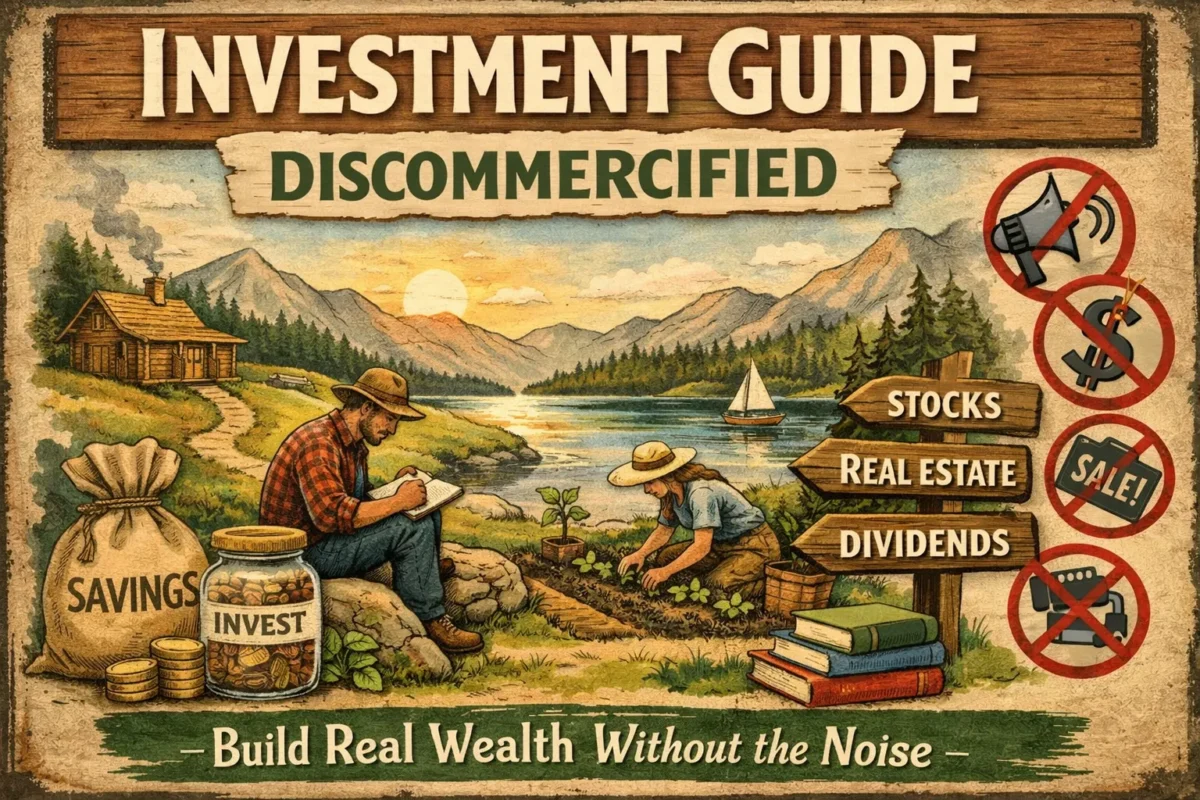
Investment Guide Discommercified: Build Real Wealth Without the Noise
Most investors spend years chasing returns they never see. Financial headlines scream urgency. Influencers push the next big thing. And somewhere in all that noise, your actual goals get lost. If you have ever felt like the entire financial world is selling you something — you are not imagining it.
This investment guide discommercified gives you a clear path out of that chaos. No jargon traps. No hidden sales agendas. Just a grounded, values-driven framework for building wealth that lasts — and that you can actually feel good about.
What Does “Discommercified” Actually Mean in Investing?
The word sounds technical. It is not.
Discommercified investing simply means stripping away the commercial pressure that distorts most financial decisions. It removes hype, urgency, and the manufactured excitement that financial marketing thrives on. What remains is something far more powerful: a strategy built on real assets, real ownership, and real value.
Think about it this way. When you buy fruit at a market stall, you pay for the fruit. When you buy an orchard, you participate in the ongoing production of fruit — season after season, regardless of what trends on social media. Discommercified investing focuses on the orchard.
the core idea is cutting through confusion in ethical and responsible investing — no jargon dumps, no hidden agendas pushing specific funds, just a clear framework for building a portfolio that aligns with your values while still making you money.
Why the Conventional Approach Keeps Failing Investors
The Problem with Hype-Driven Decisions
Most financial products are marketed like consumer goods. They carry brand identities, emotional hooks, and urgency cues designed to activate impulse rather than wisdom. “Do not miss out.” “Limited time.” “Explosive growth potential.” These phrases are sales triggers, not investment analysis.
The result? Investors make reactive decisions based on feeling rather than fundamentals. They buy high because enthusiasm peaks at highs. They sell low because fear peaks at lows. The cycle repeats.
Discommercified thinking breaks the cycle by replacing emotional triggers with structured evaluation. Before committing capital, ask one honest question: does this asset create or support real-world value? If you cannot answer that clearly, you probably should not buy it.
Spotting the Conflicts of Interest Nobody Mentions
Here is something most investment content will not tell you directly. Your financial advisor might be working against your interests — not out of malice, but because the system pays them to.
Commission-based compensation creates misaligned incentives. When an advisor earns more for recommending certain products, the recommendation becomes suspect. Proprietary product traps — where advisors only suggest in-house funds — are equally common. Those in-house options often carry higher fees and underperform alternatives available elsewhere.
One question cuts through all of it: “Are you a fiduciary?” A fiduciary carries a legal duty to prioritize your interests above their own compensation. If they hesitate or hedge their answer, that hesitation tells you something important.
Also worth knowing: fee-only advisors charge you directly with no commissions. Fee-based advisors can charge fees and collect commissions simultaneously. The naming sounds similar on purpose. The difference matters enormously.
The Three Pillars of Discommercified Investing
Pillar 1 — Long-Term Thinking as a Competitive Edge
Patience is not passive. In investing, it is one of the sharpest edges available.
Most market participants obsess over quarterly earnings and daily price swings. Their entire model demands constant activity. When you extend your time horizon to years or decades, you play a fundamentally different game — one where compounding works for you rather than against you.
Consider the math. A $10,000 investment growing at 10% annually becomes roughly $174,000 over 30 years without adding a single additional dollar. Someone trading constantly, even matching the same returns, loses significant ground to fees, taxes on every transaction, and the compounding drag those costs create.
Time smooths volatility. It rewards operational growth in businesses. And it filters out noise that would otherwise trigger poor decisions.
The practical implication: stop checking prices daily. Track business performance metrics instead. Is revenue growing? Are margins expanding? Is the company gaining or losing market share? Those signals matter. The ticker moving 2% on a Tuesday does not.
Pillar 2 — Owning Businesses, Not Betting on Tickers
When you buy a stock, you buy a piece of a real business. That business has employees, customers, products, and problems it solves every day.
Most retail investors skip this reality entirely. They see a ticker symbol flash green and treat it like a lottery ticket. They have no idea what the company actually does or whether it generates real profit. That is gambling with extra steps.
A discommercified approach asks different questions before committing capital. What problem does this company solve? How does it make money right now — not someday, but now? Who competes with it, and what stops competitors from easily replicating what it does? Is it actually profitable, or just growing revenue while burning cash?
Businesses with genuine staying power — profitable year after year, growing without lighting money on fire, run by people who actually know what they are doing — are rarer than most people assume. Finding them takes more work. Holding them through temporary turbulence takes discipline. But the alternative is chasing whatever looks exciting this quarter, which rarely builds lasting wealth.
Pillar 3 — Mastering Your Own Psychology
The market is not your biggest enemy. You are.
Fear pushes investors to sell productive assets during temporary downturns. Greed tempts them into chasing unsustainable momentum. Envy — watching peers talk about gains — triggers comparison-driven decisions that have nothing to do with sound analysis.
Behavioral finance research consistently shows that even professional traders fall victim to the same cognitive biases that hurt everyday investors. The difference between people who build real wealth and everyone else is not intelligence. It is discipline.
Practical safeguards help. Write your investment criteria before you see a specific opportunity. Define what qualifies as a good investment in advance, so excitement or fear cannot distort your evaluation in the moment. Set allocation limits that prevent any single asset from dominating your portfolio beyond a defined threshold. Schedule review periods — quarterly or annually — rather than checking performance daily. Automate contributions where possible to remove emotion from the execution entirely.
Think of emotions like weather. You cannot stop storms. But you can build structures strong enough to withstand them.
Building Your Values-Based Portfolio Step by Step
Start with Money First, Then Layer in Values
This might sound counterintuitive. People in responsible investing love to say values come first. But leading with values alone — before establishing a solid financial foundation — often produces portfolios full of feel-good investments that underperform. Six months later, frustration sets in and the whole approach gets abandoned.
Build the foundation first. Then layer your values in with intention.
Step 1: Choose a base investment. Start with a broadly diversified, low-cost ESG ETF. Not because it is perfect, but because it gives you immediate exposure without requiring deep expertise overnight. Read the prospectus — some funds screen strictly while others are more flexible with criteria than their labels suggest.
Step 2: Pick a platform that supports your goals. Find a brokerage with reasonable ESG screening tools. You will want to verify what is actually inside these funds. “Ethical” labels on funds sometimes cover companies that would surprise you.
Step 3: Define two or three priorities. Climate action? Labor practices? Corporate governance? Transparency? Pick a handful of specific concerns rather than trying to screen for everything. Trying to filter for every possible issue usually leaves nothing to invest in.
Step 4: Review annually. Company ethical ratings shift. What qualified last year may not this year. Set a calendar reminder and actually follow through.
Four steps. No manifesto required.
Understanding the Core Asset Classes in a Discommercified Strategy
Ethical Business Equity
Owning equity in a business means owning part of its productivity. When that business provides essential goods or services — food production, healthcare, logistics, sustainable technology — it participates in ongoing economic activity independent of market sentiment.
The focus here is not short-term price movement. It is operational strength: consistent revenue growth, management integrity, cost discipline, and durable market positioning. Long-term ownership in well-run businesses rewards patience as profits reinvest into growth and enterprise value compounds over time.
The discommercified approach treats ethical alignment as a core filter — looking for businesses that avoid exploitative practices, maintain transparent governance, and operate in industries with real, sustainable demand.
Purpose-Driven Real Estate
Real estate has anchored wealth for centuries because land and shelter remain fundamental human needs.
In a discommercified framework, the key distinction is purpose over speculation. Instead of asking “can I sell this for more next year?”, ask whether this property serves a genuine need. Residential housing, agricultural land, warehousing, and commercial spaces serving essential businesses all fit this profile.
Real estate also offers something most financial assets do not: hands-on influence. You can create value through development, renovation, and active management. That agency is meaningful.
Precious Metals as Stability Anchors
Gold and silver do not generate income. They preserve purchasing power over long periods and protect against currency instability.
In a discommercified portfolio, metals function as stabilizers rather than growth engines. They act like ballast in a ship — they do not propel forward movement, but they prevent capsizing in turbulent waters.
The key is proportion. Metals should complement productive assets, not replace them. A reasonable allocation provides psychological security during volatility without sacrificing the growth that equity and real estate produce over time.
The Role of Entrepreneurship in Building Real Wealth
Entrepreneurship sits at the heart of discommercified investing because it shifts your role from passive capital allocator to active value creator.
When you own or operate a business, you control the ethical standards, the operational direction, and the way value flows to employees, customers, and the community. You build equity from scratch rather than buying into someone else’s story. You reinvest profits directly and develop high-level skills alongside capital.
You do not need a large startup to benefit from this dynamic. Small service businesses, local trades, digital services, agricultural operations, and niche manufacturing can all generate strong cash flow when managed efficiently. The compounding effect of reinvesting earnings from a business you understand deeply often outperforms passive investment in companies you know nothing about.
Protecting Your Portfolio: Common Mistakes That Derail Ethical Investors
Even with clear principles, mistakes happen. Awareness limits their impact.
Overconcentration is the most common trap. Believing too strongly in a single asset — even a good one — creates unnecessary vulnerability. Spreading exposure across industries, asset classes, and geographies reduces dependency on any one outcome.
Underestimating due diligence costs investors more than they realize. Ethical branding does not guarantee operational strength. A company can publish a sustainability report and still carry weak fundamentals. Always evaluate both.
Ignoring liquidity needs leads to forced selling. Being asset-rich and cash-poor means selling productive investments at inconvenient times, often during downturns when prices are low. Maintain accessible reserves before locking capital into illiquid assets.
Confusing activity with progress is a quieter mistake. Frequent trading and constant portfolio changes rarely improve returns. Holding quality assets through volatility, while uncomfortable, typically outperforms reactive repositioning.
Building Wealth That Outlasts You
Genuine financial success extends beyond personal comfort. It creates stability for the people and causes that come after you.
Generational wealth is not just about transferring assets. It requires transferring knowledge, values, financial literacy, and a sense of responsibility alongside those assets. Wealth handed down without wisdom dissolves. Wisdom passed alongside wealth multiplies.
The discommercified approach to generational wealth focuses on community as much as capital. Investing in local enterprises, ethical cooperatives, community housing, and transparent business partnerships builds both financial returns and the kind of social infrastructure that sustains a community through economic cycles.
Conclusion: Real Wealth Does Not Need Noise to Grow
The investment guide discommercified philosophy is not about rejecting opportunity. It is about redefining what opportunity actually looks like.
Real wealth grows quietly. It compounds through ownership, patience, and honest evaluation of what assets genuinely produce. It does not need hype to sustain it. It does not require you to check prices every hour or react to every financial headline.
Markets will rise and fall. Trends will come and go. But productive assets aligned with real human needs stay relevant across cycles.
Build steadily. Think long term. Let your investments reflect both your financial goals and the world you want to support. That combination — more than any hot tip or trending strategy — is what creates wealth worth having.
Frequently Asked Questions
What is the investment guide discommercified approach and how does it work?
The investment guide discommercified approach removes hype and commercial pressure from financial decision-making, focusing instead on real assets, long-term ownership, and values-aligned investing. It prioritizes businesses and assets that create genuine economic value over speculative products designed primarily for trading.
How do I know if an ESG fund is actually ethical or just greenwashing?
Read the fund prospectus, not just the marketing label. Check which companies the fund actually holds and what screening criteria it applies. Some ESG funds screen strictly while others use flexible standards that allow questionable holdings. Independent ESG rating platforms also provide company-level assessments worth reviewing before committing capital.
Is it possible to build real wealth through ethical investing without sacrificing returns?
Yes. Research consistently shows that values-aligned strategies can match or outperform conventional approaches, particularly over longer time horizons. The key is grounding ethical choices in sound fundamentals — choosing businesses with strong operational performance and durable competitive advantages, not just companies with positive brand images.
How do I avoid conflicts of interest when choosing a financial advisor?
Ask directly whether the advisor operates as a fiduciary, meaning they are legally required to prioritize your interests. Request to see their Form ADV Part 2, which discloses compensation structure and conflicts publicly. Prefer fee-only advisors who charge you directly without earning commissions on product sales.