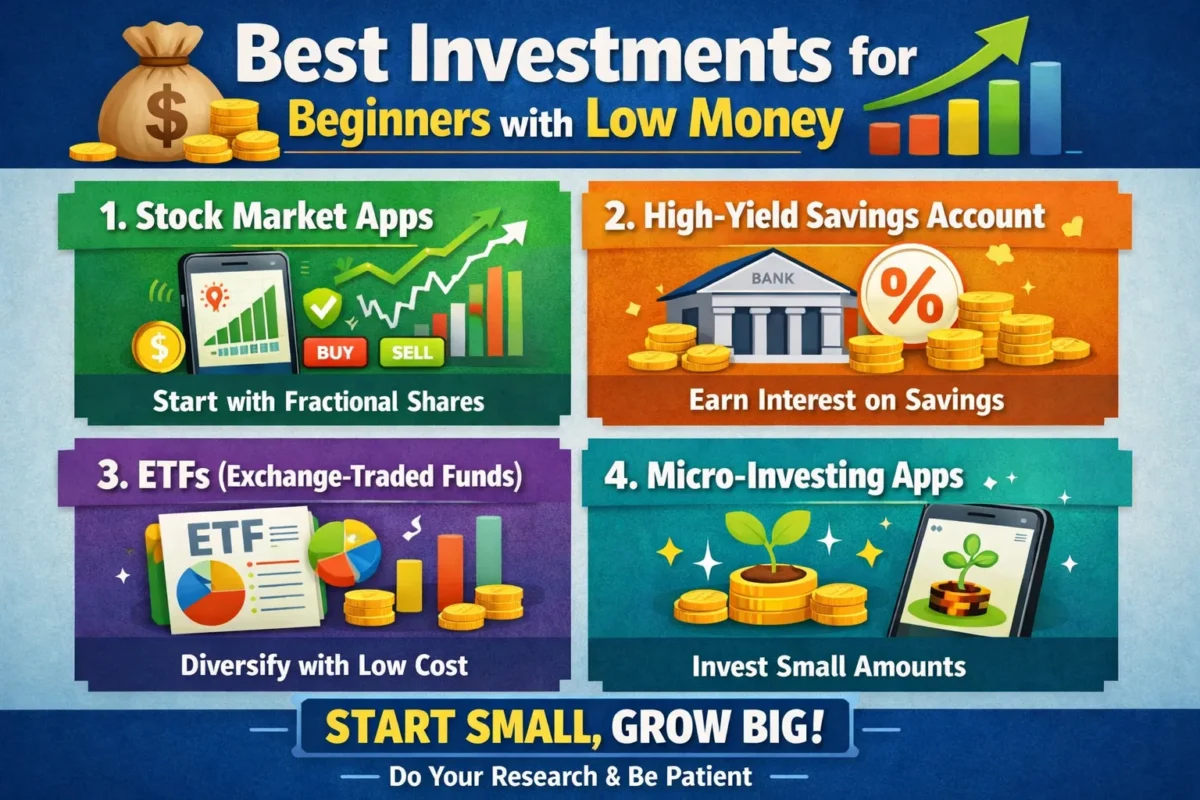
Best Investment for Beginners with Low Money
You want to invest. Your bank account disagrees. Sound familiar? Starting your investment journey with limited funds feels like being handed a game with all the rules missing. Most guides assume you already have a lump sum sitting around. You probably do not. That gap between wanting to invest and knowing how to start small is exactly what this article closes.
Here is the good news: the best investment for beginners with low money is not about chasing stocks or timing the market. It is about building something real, starting where you are, and growing from there. By the end of this guide, you will know exactly what to invest in, why it works, and how to take your first step today.
Why Most Beginners Think They Cannot Start Yet
The Waiting Trap
Most beginners fall into a quiet trap. They tell themselves they will start investing once they have more money. Then more money arrives, and the goal shifts again. Waiting becomes a habit. Meanwhile, time — the most powerful ingredient in any investment — keeps passing.
The truth is uncomfortable but freeing: the amount you start with matters far less than the decision to start. Small, consistent action beats large, delayed action every single time. Compounding does not care how much you begin with. It rewards consistency.
The Myth of Minimum Capital
Many people assume investing requires thousands of dollars. That assumption belongs to an older era. Today, the landscape looks completely different. You can invest in index funds with as little as a few dollars. You can build a skill-based income stream with zero capital. You can create digital products and earn passive income without a warehouse or a storefront.
The barriers to entry have collapsed. What remains is mindset, not money.
The Best Investments for Beginners with Low Money
1. Invest in Yourself First
This is not a motivational cliche. It is the single highest-return investment available to any beginner. Learning a marketable skill — writing, coding, design, video editing, or data analysis — costs very little but pays for decades.
Consider this: one freelance writing skill can generate consistent monthly income. One design skill can turn into a consulting business. One coding skill can unlock remote work opportunities worldwide. The return on a skill compounds every time you use it.
when money is limited, “time, skills, energy, and curiosity are far more valuable than currency.” That framing changes everything. You are not behind. You are building the engine before filling the tank.
How to start: Pick one skill you find genuinely interesting. Spend 30 minutes a day practicing it. Free resources exist on YouTube, Coursera, and dozens of open-access platforms. Within three to six months, you will have something worth offering.
2. Index Funds and Fractional Shares
Once you have even a small amount of cash to invest — think $10 or $25 — index funds are one of the smartest places to put it. An index fund tracks a broad market index, spreading your money across hundreds of companies at once. This reduces risk while giving you exposure to long-term market growth.
Fractional shares take this further. Many brokerages now allow you to buy a slice of a company rather than a full share. That means you can own a piece of a major company for a few dollars instead of hundreds.
The magic here is consistency. Invest small amounts regularly. Even $20 a month, invested consistently over years, grows meaningfully thanks to compound interest. Time does the heavy lifting. Your job is to stay in the market and not panic when it dips.
Key principle: Do not try to time the market. Time in the market beats timing the market, every single time.
3. High-Yield Savings Accounts
Before you dive into market-based investing, build a small emergency buffer. A high-yield savings account earns significantly more interest than a standard savings account — sometimes 4% to 5% annually depending on current rates.
This is not glamorous. But it serves a critical purpose. When an unexpected expense hits, you will not need to sell your investments at a loss. Your investment portfolio stays intact. Your emergency fund handles the crisis.
Start with a goal of one month of essential expenses. Build from there. This foundation protects everything else you build.
4. Micro-Investing Apps
Several platforms now let beginners invest spare change automatically. Apps round up your everyday purchases to the nearest dollar and invest the difference. Buy a coffee for $3.40, and $0.60 goes into your investment portfolio.
This approach removes the decision entirely. You do not have to remember to invest. The system does it for you. Over time, these small amounts accumulate into a meaningful balance.
For beginners who struggle with consistency, this low-friction approach builds the habit of investing before the habit of spending extra. That habit shift matters more than the dollar amounts in the early stages.
5. Create Digital Products
A digital product is anything you create once and sell repeatedly. Templates, guides, ebooks, Notion dashboards, Canva designs — the list is long. The upfront cost is time and effort, not money.
Once created, a digital product sits in an online marketplace and generates income while you sleep. It does not require customer service teams, inventory, or shipping logistics. It scales with almost no additional cost.
As noted creative assets are powerful because they “can be reused endlessly.” One guide can serve hundreds of buyers. One template can generate income for years.
Where to start: Identify a problem you have already solved. Turn your solution into a simple, well-structured product. Upload it to a platform like Gumroad or Etsy. Price it modestly and refine based on feedback.
6. Start a Micro-Service Business
A micro-service business offers a single, focused service at an accessible price point. Think resume writing, social media post creation, data entry, transcription, or basic bookkeeping.
You need no startup capital. You need a skill and an internet connection. Platforms like Fiverr, Upwork, and PeoplePerHour connect you with clients immediately. Start with one service. Do it exceptionally well. Let reviews and reputation grow your client base.
This approach turns your time into income with zero financial risk. Every dollar earned can then be reinvested — into better skills, better tools, or market-based investments.
7. Reinvest Every Small Win
The most powerful habit beginners can build is reinvestment. When you earn your first $50 from a freelance job or digital product, the temptation is to spend it. Resist that temptation.
Put it back into growth. Buy a course that sharpens your skill. Invest it in index funds. Use it to improve your product quality. Each reinvestment accelerates momentum.
Think of it as a snowball rolling downhill. The first rotation is slow and awkward. By the hundredth rotation, the ball barely needs a push.
What to Avoid as a Beginner Investor
Chasing Quick Wins
Cryptocurrency speculation, penny stocks, and viral investment schemes prey specifically on beginners with limited funds. They promise massive returns quickly. They rarely deliver. And when they fail, they take your limited capital with them.
Slow, boring, consistent investing outperforms exciting, risky bets over any meaningful time horizon. The exciting stuff makes for better social media content. The boring stuff builds actual wealth.
Spreading Too Thin Too Early
Trying five different investment strategies at once guarantees mediocrity in all of them. Pick one or two approaches that match your current skills and resources. Go deep. Build traction. Only expand once you have something working.
Skipping the Emergency Fund
Investing before you have any financial buffer is dangerous. If an emergency forces you to liquidate investments quickly, you may sell at a loss and undo months of progress. Build the safety net first, then build the portfolio.
Building the Right Mindset for Long-Term Success
Consistency Beats Intensity
Investing $20 a month for 12 months beats investing $500 once and never again. The habit matters more than the amount in the early stages. Build the rhythm first. Increase the amounts as your income grows.
Track Progress Without Obsession
Check your investments monthly, not daily. Daily price movements are noise. Long-term trends are signal. Obsessive checking leads to emotional decisions, which leads to selling low and buying high — the exact opposite of what you want.
Set a monthly review date. Note what worked. Note what did not. Adjust slowly. Stay consistent.
Surround Yourself with the Right Information
The information you consume shapes your decisions. Follow credible financial educators. Read personal finance books. Engage with communities of people building wealth from small beginnings.
Avoid financial entertainment that thrives on fear and hype. It generates clicks. It does not generate returns.
A Simple Starter Plan for Beginners with Low Money
Here is a straightforward roadmap to get started immediately:
Month 1: Open a high-yield savings account. Set a savings goal of one month of essential expenses. Identify one skill you want to develop.
Months 2 to 3: Dedicate 30 minutes daily to developing that skill. Begin offering a micro-service or building a simple digital product. Download a micro-investing app and activate automatic round-ups.
Month 4 onwards: Open a brokerage account. Begin investing $10 to $20 monthly into an index fund. Reinvest every dollar earned from micro-services or digital products. Review progress monthly and adjust.
This plan costs almost nothing to start. It builds multiple income streams simultaneously. And it gets better every single month you stay committed.
Conclusion
The best investment for beginners with low money is not a single magic asset or a secret portfolio. It is a combination of self-investment, consistent market participation, and smart reinvestment of early earnings. You do not need a lot of money to start. You need a decision, a plan, and the patience to see it through.
Start with what you have. Invest in what you know. Build from there. The difference between people who build wealth and people who wish they had is not luck or starting capital. It is the moment they decided to begin.
That moment can be today.
FAQ — People Also Ask
Q1: What is the best investment for beginners who have less than $100? Start with a high-yield savings account to build a small buffer, then put $10 to $20 monthly into an index fund through a micro-investing app. Simultaneously, develop one marketable skill. These three steps together give beginners a real financial foundation with almost no starting capital.
Q2: Can I start investing with just $10 a month? Yes. Many brokerages now allow fractional share purchases starting at $1. Investing $10 monthly into an index fund builds the habit of investing and benefits from compound growth over time. Consistency matters far more than the dollar amount when you are starting out.
Q3: Is investing in yourself actually a real investment for beginners? Absolutely. Learning a marketable skill — writing, design, coding, or editing — can generate income repeatedly with zero ongoing cost. A skill compounds every time you use it. For beginners with limited money, this is often the highest-return investment available and requires no brokerage account.
Q4: How do beginners avoid losing money when they start investing? Stick to low-risk, diversified options like index funds rather than individual stocks or speculative assets. Build an emergency fund first so you never need to sell investments in a panic. Start small, learn consistently, and avoid chasing quick returns. Slow and steady is the proven path for beginners.

Scott Dexter is a finance and journalism enthusiast with a deep interest in Islamic business principles. He shares practical insights, ethical financial knowledge, and easy-to-understand guidance to help readers make informed decisions.