5 Major Applications of IoT in Transportation That Are Reshaping How We Move
Transportation has always been the backbone of modern civilization. But today, it’s getting smarter — faster — and more connected than ever before. Thanks to IoT in transportation, roads, vehicles, and transit systems are no longer just physical infrastructure. They’re intelligent networks generating real-time data and making split-second decisions.
The stakes are high. Urban populations are expanding, traffic congestion is costing billions in lost productivity, and logistics networks face relentless pressure to deliver faster. The good news? Connected technology is already solving these problems. In this post, you’ll discover the five most impactful applications transforming the transportation industry right now — and why they matter to cities, businesses, and everyday commuters alike.
1. Smarter Traffic Management
Traffic congestion isn’t just frustrating — it’s expensive. According to INRIX research, drivers in major cities lose hundreds of hours each year sitting in gridlock. Traditional traffic systems simply can’t keep up with unpredictable, ever-shifting traffic flows.
That’s where connected sensors change everything.
How IoT Makes Traffic Flow Smarter
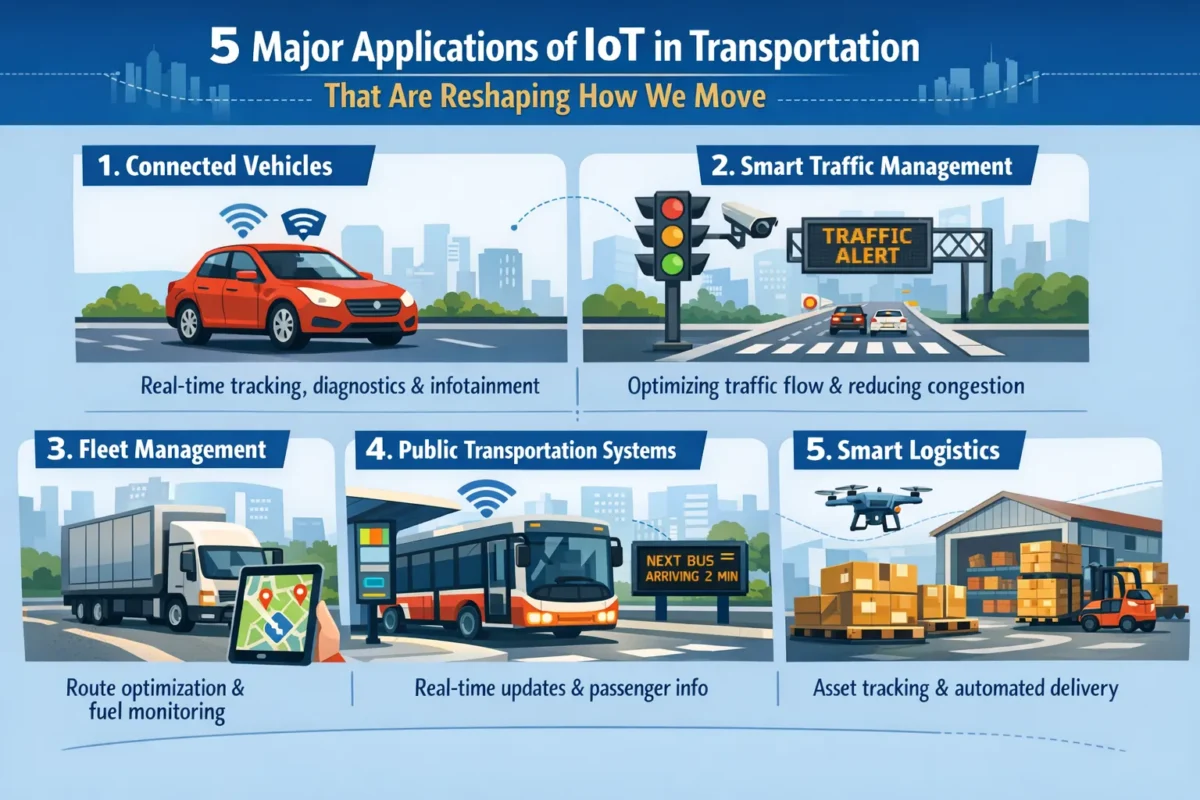
Thousands of cameras, embedded road sensors, and smart traffic signals now feed real-time data into centralized traffic management platforms. Cities use this stream of information to adjust signal timing dynamically, reroute traffic around bottlenecks, and respond to accidents within seconds — not minutes.
Smart parking is another game-changer. Sensors installed in parking bays detect occupancy and relay that data to mobile apps, guiding drivers directly to open spots. Less circling. Less frustration. Fewer emissions. IoT for All highlights this as one of the fastest-growing areas of urban mobility investment.
Beyond convenience, adaptive traffic systems reduce accident risk at busy intersections and lower fuel consumption across entire road networks. The city moves better when every signal knows exactly what traffic looks like right now — not five minutes ago.
2. Automated Toll and Ticketing Systems
Remember sitting in a long toll booth queue, hunting for exact change? That experience is rapidly disappearing. One of the most practical IoT applications in transportation is the automation of toll collection and transit ticketing.
From Manual Booths to Seamless Payments
RFID tags, license plate recognition cameras, and connected payment gateways work together to identify vehicles and process payments without anyone slowing down or stopping. A vehicle approaching a highway toll plaza gets detected, authenticated, and charged — all before it even reaches the booth.
For public transit, smart ticketing systems let passengers tap and go using contactless cards or smartphones. No paper tickets. No queues. Just seamless movement. Digi’s transportation IoT solutions overview explains how these systems reduce operational costs for transit authorities while dramatically improving passenger experience.
What makes this particularly powerful is the flexibility. Newer vehicles carry built-in connectivity. Older ones? The driver’s smartphone bridges the gap, linking to digital wallets and processing payments automatically. The system works for everyone.
3. Fleet Tracking and Transportation Monitoring
For logistics companies, fleet visibility isn’t a luxury — it’s a competitive necessity. Every minute a driver spends lost, idling, or stuck on an inefficient route costs money. Real-time fleet monitoring through connected devices eliminates that waste.
Visibility That Drives Better Decisions
GPS trackers combined with IoT sensors give fleet managers a live view of every vehicle’s location, speed, fuel consumption, and mechanical health. If a truck deviates from its planned route, dispatchers know instantly. If engine diagnostics flag an issue, maintenance gets scheduled before a breakdown happens on the road.
Driver behavior monitoring adds another layer of value. Hard braking, sharp cornering, and excessive idling all get flagged — giving managers the data they need to coach drivers, reduce wear on vehicles, and cut fuel costs significantly. PLS Logistics reports that IoT-enabled fleet management can reduce fuel expenses by up to 15% and maintenance costs by an even greater margin.
For IoT in transportation and logistics specifically, this application creates a ripple effect. Shippers gain accurate ETAs. Customers get proactive delivery updates. Supply chains become more resilient because problems get spotted early — not after they’ve already caused delays.
4. Autonomous and Connected Vehicles
Self-driving cars were once science fiction. Today, they’re road-tested reality. The entire concept rests on an intricate web of IoT sensors working in perfect synchronization.
The Sensor Network Behind Autonomous Driving
Autonomous vehicles rely on a combination of LiDAR, radar, ultrasonic sensors, cameras, and GPS to build a real-time picture of their surroundings. Every millisecond, these sensors collect data about other vehicles, pedestrians, road markings, and obstacles. That data streams to onboard processors and cloud systems, which make driving decisions faster and more accurately than any human could.
But autonomous vehicles don’t operate in isolation. Vehicle-to-vehicle (V2V) and vehicle-to-infrastructure (V2I) communication — both core components of the broader IoT ecosystem — let cars share hazard warnings, speed recommendations, and traffic conditions with each other and with road infrastructure. A connected vehicle approaching an intersection can receive a signal from the traffic light telling it to slow down before the human eye even registers the color change.
The application of IoT in transportation goes far beyond individual vehicles here. When fleets of autonomous trucks or buses operate as connected systems, efficiency gains multiply across entire networks — fewer accidents, optimized routing, lower emissions, and dramatically reduced operating costs.
5. Enhanced Public Transport Security and Passenger Safety
Public safety on transit systems has always been a challenge. Overcrowded buses, unmanned stations, and limited visibility create real risks. Connected technology addresses this directly — and comprehensively.
Smarter Surveillance, Safer Journeys
IoT-enabled CCTV networks go beyond passive recording. Modern smart cameras analyze footage in real time, detecting unusual behavior, unauthorized access, or crowd surges and alerting security personnel immediately. Sensors on bus and rail doors monitor passenger flow and prevent dangerous overcrowding.
Beyond security, passenger information systems powered by connected infrastructure keep commuters informed at every step. Real-time arrival boards, mobile app notifications, and automated announcements reduce uncertainty and make public transport a more attractive option compared to private vehicles.
Automated fare collection systems — another core IoT application in transportation — reduce the need for ticket inspectors and minimize revenue leakage. Every transaction gets logged, every journey gets tracked, and system managers gain insights that help them allocate resources exactly where demand is highest.
Conurets notes that integrated IoT solutions in public transport have made it possible for transit agencies to establish direct, real-time communication with passengers — something that simply wasn’t possible with older infrastructure. The result is a public transport experience that feels more reliable, more responsive, and significantly safer.
The Road Ahead
The IoT in transportation industry is moving fast. From adaptive traffic signals to self-driving vehicles, every application described here is already operational in cities and logistics networks around the world. And the momentum isn’t slowing down — Allied Market Research has projected the global market for connected transportation solutions to reach hundreds of billions of dollars, reflecting just how central this technology has become.
What ties all five applications together is a simple principle: better data leads to better decisions. When roads, vehicles, and transit systems share information in real time, the entire network becomes more efficient, safer, and more sustainable. For city planners, logistics operators, and everyday commuters, that’s not just a technological advancement — it’s a fundamental improvement in quality of life.
The question isn’t whether connected technology will transform transportation. It already has. The question is how quickly organizations will embrace it — and how much they’ll leave on the table if they don’t.
Frequently Asked Questions
What are the major applications of IoT in transportation?
The major applications of IoT in transportation include intelligent traffic management, automated toll and ticketing, real-time fleet tracking, autonomous vehicle systems, and smart public transport security. Each application uses connected sensors and data platforms to make transportation safer, faster, and more efficient. Together, they address the biggest pain points in modern mobility — congestion, cost, safety, and reliability.
What are the 5 applications of IoT?
In the context of transportation, the five key IoT applications are: (1) smart traffic signal control and congestion management, (2) automated tolling and fare collection, (3) GPS-based fleet monitoring and logistics optimization, (4) sensor-driven autonomous and connected vehicles, and (5) IoT-powered public transport safety and passenger information systems. Each one relies on a network of sensors, cloud platforms, and real-time data processing to deliver meaningful improvements.
What are the 4 types of IoT applications?
IoT applications generally fall into four categories: consumer IoT (smart home devices and wearables), commercial IoT (fleet management, building automation), industrial IoT or IIoT (manufacturing sensors, supply chain systems), and infrastructure IoT (smart city systems like traffic control and connected transit). Transportation spans all four — from the apps passengers use to check bus arrivals, to the industrial sensors monitoring freight trucks across interstate highways.
What is IoT transportation?
IoT transportation refers to the use of interconnected sensors, devices, and software platforms to collect, transmit, and analyze data across transportation systems. This includes vehicles, roads, transit networks, and logistics infrastructure. The goal is to make movement smarter — reducing delays, improving safety, cutting costs, and enabling more informed decisions at every level, from individual vehicles to city-wide traffic management.