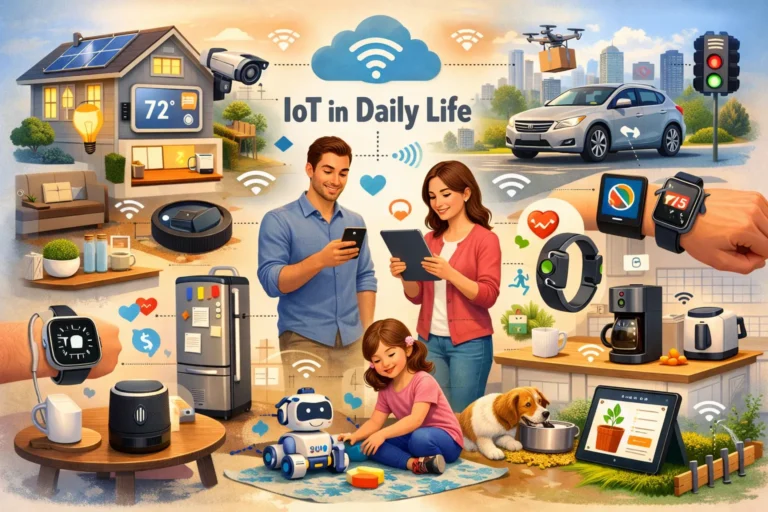

Edge Computing in IoT: How It Works, Why It Matters, and Where It’s Heading
Every second, billions of connected devices generate data — and the gap between collecting that data and actually using it is where most systems break down. Slow response times, overloaded networks, and security gaps all trace back to one core problem: processing everything through a distant cloud. That’s exactly what edge computing in IoT solves, and this guide walks you through the full picture.
You’ll leave with a clear understanding of how edge computing works alongside IoT, why industries are racing to adopt it, and what real-world results actually look like. No fluff — just the structure you need to understand one of the most significant technology shifts of the decade.
What Is Edge Computing in IoT, Really?
Before diving deep, let’s clear up a common mix-up. IoT and edge computing are not the same thing — they’re complementary. IoT refers to the network of physical devices embedded with sensors and software that collect and share data. Edge computing is the framework that processes that data closer to where it originates, rather than routing it to a centralized data center first.
Think of it this way: IoT is the data generator. Edge computing is the data processor that sits right next to it.
Edge computing for the Internet of Things is the practice of processing and analyzing data closer to the devices that collect it, rather than transporting it to a data center first. Today, it has become an essential complementary technology to IoT, helping speed data processing times, reduce latency, and improve security across a wide range of connected devices.
The distinction matters because most IoT deployments fail not due to weak hardware — but due to the distance data must travel before anything useful happens with it. Edge computing closes that gap decisively.
How Edge Computing in IoT Actually Works
The architecture is elegant in its simplicity. Data doesn’t have to sprint across the internet to reach a cloud server just to tell a machine to shut off. Instead, the processing happens locally — fast, secure, and independent.
IoT edge computing uses devices and sensors to push data through a system, process, and store it — all without transporting it to a data center. By spreading workloads across multiple devices, it ensures that no single device ever gets overloaded.
Here’s the step-by-step flow that makes it work:
1. Data Collection — A sensor on an IoT device captures real-world inputs. A wind turbine measures speed and direction. A factory floor sensor monitors temperature. A wearable device tracks heart rate.
2. Local Processing — That raw data routes through an edge device — typically a gateway or a nearby server — where it gets analyzed using local computing resources. No internet required for this step.
3. Data Filtering — Not everything gets kept. The edge device discards irrelevant readings and retains only what carries actionable value. This alone saves enormous bandwidth.
4. Automated Response — Here’s where the real power surfaces. Edge computing enables automated decision-making for some IoT devices. Sensors can be programmed to take certain actions based on real-time data — for example, shutting down a machine that’s overheating or turning an autonomous vehicle to prevent a crash.
5. Selective Cloud Sync — Only the most meaningful data travels to the cloud for long-term storage, deeper analytics, or business intelligence purposes.
This layered approach makes the entire IoT ecosystem faster, smarter, and dramatically more resilient.
Why Businesses Can’t Ignore This Anymore
The numbers tell a compelling story. A recent report projected that the number of IoT devices worldwide would reach 18 billion by the end of 2025. According to Fortune Business Insights, the global market for edge computing was valued at a little over USD 10 billion just two years ago and is expected to reach USD 182 billion over the next six years — a compound annual growth rate of 38.2%.
That’s not a trend. That’s a structural shift in how industries operate.
The driving force behind this growth is straightforward: latency kills performance. In healthcare, a delayed alert costs lives. In manufacturing, a missed anomaly causes equipment failure. In autonomous vehicles, even a fraction of a second matters. Edge computing in IoT removes the bottleneck that cloud-only architectures can’t eliminate.
The Five Core Benefits Worth Understanding
1. Near-Zero Latency for Time-Sensitive Decisions
Edge computing allows smart applications and devices to respond to data almost in real time — a critical factor for businesses and self-driving vehicles alike. When the action must happen in milliseconds, waiting for the cloud simply isn’t an option.
2. Dramatically Reduced Bandwidth Costs
This technology increases efficient bandwidth usage by analyzing data at the edge itself, unlike cloud solutions which require transferring data from IoT devices — making it especially useful in remote locations with minimum cost. Manufacturing plants, offshore oil rigs, and rural agricultural operations all benefit from this directly.
3. Stronger Data Security
Edge computing has the ability to process data without putting it on a public cloud, ensuring full security. The less data that travels across networks, the smaller the attack surface becomes. For healthcare providers handling patient data and financial institutions managing transactions, that’s not just a nice-to-have — it’s a regulatory requirement.
4. Resilience Without Constant Connectivity
Not every IoT deployment enjoys a reliable internet connection. Remote pipelines, agricultural sensors, and deep-sea equipment all operate in low-connectivity environments. Edge computing allows local processing to continue uninterrupted even when cloud access drops.
5. Smarter Automation Through Machine Learning
Using machine learning, IoT and edge devices can be trained to make predictions and initiate responses based on data they have collected, stored, and processed. ML APIs collect data from IoT edge devices and use algorithms to spot patterns, changes in environmental conditions, and more — enabling the edge device to detect anomalies and trigger automated processes.
A water management system that opens drainage channels to prevent flooding — without any human intervention — is already a reality. Edge computing in IoT makes it possible.
Real-World Use Cases That Prove the Value
Smart Manufacturing
On factory floors, sensors monitor machinery in real time. The edge device processes vibration data, temperature readings, and pressure measurements locally — identifying failure signatures before a breakdown occurs. The result? Predictive maintenance replaces costly reactive repairs.
Autonomous Vehicles
Intel estimates that autonomous vehicles, with hundreds of on-vehicle sensors, generate 40 TB of data for every eight hours of driving. Sending all that data to the cloud is unsafe and impractical. Edge computing lets the vehicle process critical environmental data on-board, responding to road conditions in fractions of a second.
Healthcare Monitoring
Many modern applications depend on edge computing for their functionality — including connected devices that enable healthcare professionals to monitor patients remotely. Wearable patient monitors process vitals locally, flagging emergencies and alerting staff without routing sensitive health data through external servers.
Smart Traffic Management
Cities use edge-enabled sensors to monitor intersections, adjust signal timing in real time, and reduce congestion. The processing happens at the edge — locally, immediately, and without depending on a distant data center to respond.
Precision Agriculture
Agricultural IoT sensors track soil moisture, weather conditions, and crop health across vast fields. Edge processing acts on that data to control irrigation systems, optimize resource use, and alert farmers to problems — all without requiring reliable connectivity in every acre.
The Challenges You Should Know About
Edge computing in IoT delivers genuine advantages, but it also introduces real complexity. Awareness of the friction points leads to smarter deployment decisions.
Infrastructure at Scale — Managing hundreds or thousands of distributed edge devices across a wide geography requires thoughtful orchestration. Updates, patches, and monitoring must work seamlessly across every node. Setting up and maintaining edge computing systems can be challenging, especially when many devices or a vast geographic region is involved.
Hardware Constraints — Edge devices aren’t data centers. Edge devices frequently have constrained processing, storage, and bandwidth, which can restrict their capacity to carry out specific activities. Designing applications that operate efficiently within those limits requires discipline and deliberate architecture.
Consistency Across the Network — When processing happens at the edge, ensuring that every node applies the same logic and produces consistent outputs becomes an ongoing operational challenge. Governance and standardization matter more as deployments grow.
None of these challenges are insurmountable — but approaching edge deployment without acknowledging them leads to fragile systems.
Edge Computing vs. Fog Computing: A Brief Distinction
These two terms often surface together, and the difference is worth knowing. Edge computing is more specific towards computational processes for edge devices. Fog computing includes edge computing but also encompasses the broader network that carries processed data to its final destination.
In practical terms: edge computing happens on or immediately next to the device. Fog computing is the wider distributed architecture that connects edge nodes to cloud infrastructure. For most IoT deployments, edge computing is the relevant layer — fog is the larger ecosystem it operates within.
The Role of IoT Gateways
Through a device known as an IoT gateway, edge computing and IoT devices connect with modern cloud computing environments to improve data filtering and analytics. IoT gateways are small devices designed to connect IoT devices to the cloud by translating communication protocols and collecting and processing data locally. They use encryption capabilities to make data unreadable as it moves between devices, users, and the cloud — ensuring only authorized users can access it.
The gateway acts as the critical bridge — local enough to maintain speed, connected enough to enable broader intelligence.
What’s Coming Next
The convergence of 5G networks and edge computing is already reshaping expectations. Faster wireless speeds dramatically expand what’s possible at the edge — enabling richer real-time applications, denser sensor deployments, and more sophisticated automation across entire cities and industries.
Simultaneously, machine learning capabilities are moving closer to the device itself. “TinyML” — ultra-lightweight models running directly on microcontrollers — means inference happens not just at a nearby gateway, but inside the sensor itself. The edge is getting sharper.
For any organization building on IoT infrastructure today, designing with edge computing in IoT from the start isn’t just smart architecture — it’s a competitive necessity.
Conclusion
Edge computing and IoT don’t just work better together — they’re built for each other. IoT creates the data. Edge computing makes it instantly useful. The combination delivers faster responses, reduced bandwidth demands, tighter security, and systems that keep running even when connectivity fails.
The shift toward distributed, edge-first IoT infrastructure is well underway. Understanding how edge computing in IoT works and where it fits in your own context puts you ahead of the curve — and that’s exactly the kind of clarity this guide was built to give you.
Frequently Asked Questions
Q1: What does edge computing actually do in an IoT system?
Edge computing processes IoT data directly at or near the device that collected it, rather than sending everything to a distant cloud server first. This reduces latency, lowers bandwidth usage, and enables faster automated decisions. In practical terms, it means a manufacturing sensor can shut down a faulty machine in milliseconds — without waiting for a round-trip to the cloud.
Q2: Is edge computing in IoT better than using cloud alone?
For time-sensitive applications, edge computing significantly outperforms a cloud-only approach. The cloud excels at large-scale data analysis, long-term storage, and business intelligence. Edge computing handles real-time decision-making at the device level. Most mature IoT deployments use both — edge processing for immediate responses, cloud for deeper insights. It’s a partnership, not a competition.
Q3: How does edge computing improve IoT security?
By keeping sensitive data local and limiting what actually travels across public networks, edge computing shrinks the exposure window for cyberattacks. Less data in transit means fewer interception opportunities. IoT gateways add another layer by encrypting data between devices and cloud environments, ensuring only authorized access at every step of the data flow.
Q4: What industries benefit most from edge computing in IoT right now?
Manufacturing, healthcare, transportation, agriculture, and smart city infrastructure are seeing the most immediate impact. Autonomous vehicles process sensor data on-board for real-time navigation. Hospitals use edge-enabled wearables for remote patient monitoring. Factories run predictive maintenance using local processing on equipment sensors. Any sector where delayed data equals a costly outcome stands to gain substantially from edge computing in IoT.
References
- IBM Think — Edge Computing for IoT
- Teguar — Edge Computing vs IoT: What Is the Difference?
- GeeksforGeeks — Edge Computing